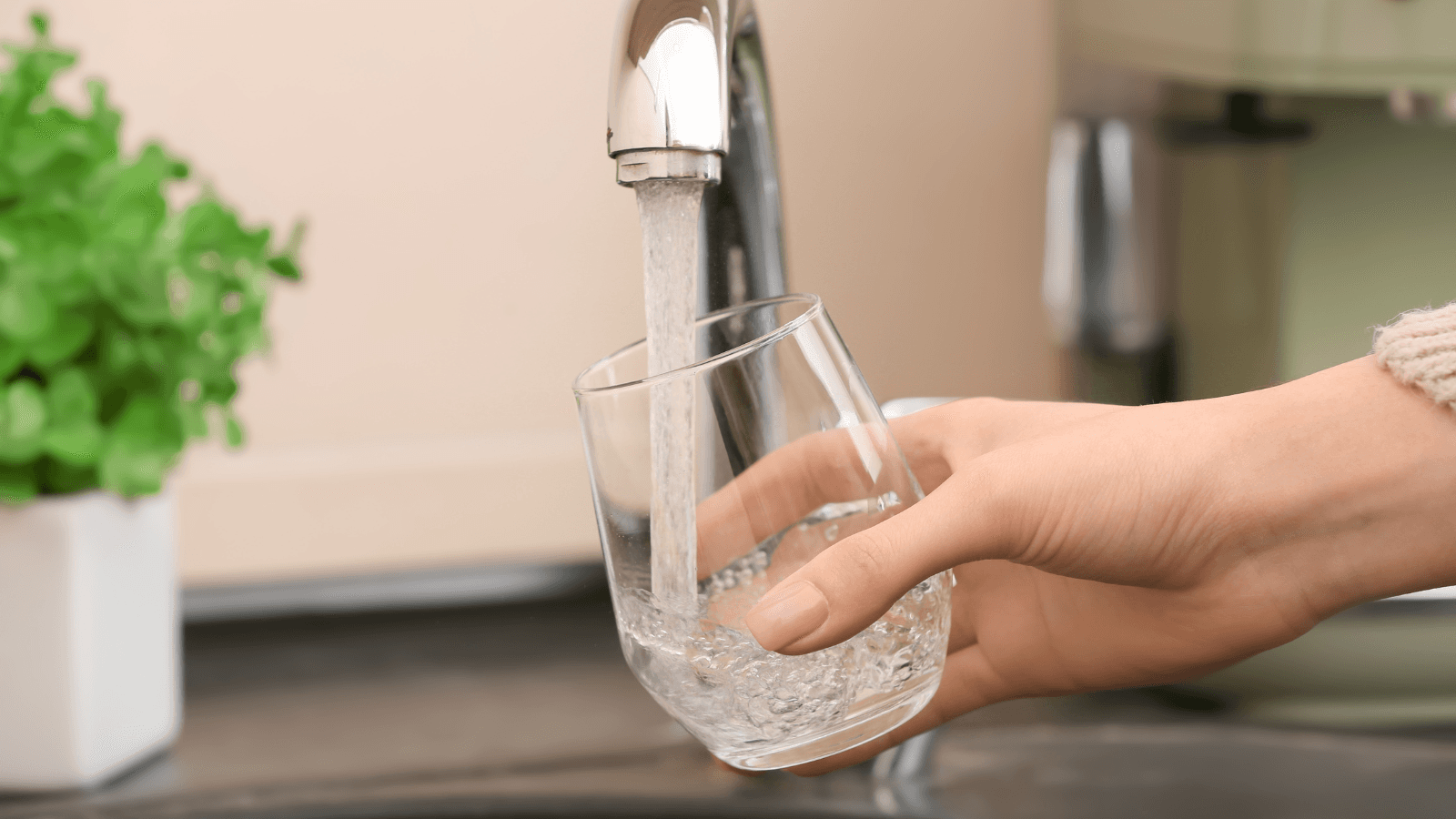
You can sometimes smell it when you fill a glass from the tap. That faint pool-water scent is chlorine, and it is there on purpose.
Chlorine is the primary reason waterborne diseases that killed thousands of Americans in the early 1900s are now essentially eliminated. Water utilities have used it since 1908 to kill bacteria, viruses, and other pathogens before water reaches your home. It works. It is one of the most effective public health interventions in history.
That does not mean it belongs in your glass.
What Chlorine Does After It Leaves the Treatment Plant
Chlorine's job is disinfection. It does that job at the treatment plant, and it continues doing it as water travels through miles of distribution pipes to reach your home — which can take hours or even days depending on how far you are from the plant.
By the time water reaches your tap, the chlorine has done its work. You do not need it in your drinking water. You do not need it in your shower. The disinfection that protects public health happened upstream. What stays in your water is a residual that the utility maintains to prevent recontamination in the pipes — not something your body needs.
The question is not whether chlorine serves a purpose. It does. The question is whether you want to continue consuming it at the tap when there is a straightforward way to remove it.
Chlorine vs. Chloramine — This Distinction Matters for Filtration
Here is something most homeowners do not know: some utilities use chlorine, and some use chloramine — a compound formed by combining chlorine with ammonia. More than one in five Americans drinks water treated with chloramines, according to the EPA. Some utilities switch between the two seasonally.
Why does this matter for filtration? Because standard carbon filters — pitcher filters, refrigerator filters, basic under-sink carbon blocks — remove chlorine effectively but do not remove chloramine reliably. Chloramine requires catalytic carbon, a different and more specialized filtration media. If your utility uses chloramines and you have a standard carbon filter, it may not be doing what you think it is doing.
Across East Tennessee, most utilities use surface water sourced from rivers and lakes, which typically requires a persistent disinfectant in the distribution system. Whether your specific utility uses chlorine or chloramine can change seasonally and is worth knowing. Your water utility's annual Consumer Confidence Report will list which disinfectant is used.
The Disinfection Byproduct Problem
This is where the health discussion gets specific.
When chlorine or chloramine reacts with organic matter naturally present in source water — decaying leaves, algae, soil — it forms compounds called disinfection byproducts, or DBPs. The two most studied families are trihalomethanes (TTHMs) and haloacetic acids (HAAs).
Both are regulated by the EPA. Both are linked to increased cancer risk with long-term exposure. And both show up in the EWG Tap Water Database for Tri-Cities utilities above EWG's health guidelines, even when they fall within legal limits.
The Johnson City Water Department's EWG data, for example, shows chloroform — a TTHM — at 52 times above EWG's health guideline and bromodichloromethane at 64 times above the guideline. These are disinfection byproducts. The utility is in full legal compliance. The gap between "legal" and "health-protective" is where DBPs typically live.
Chloramine produces fewer TTHMs than free chlorine, which is one reason utilities switched to it. But chloramine has its own byproduct concerns — it can produce nitrosamines, some of which are suspected human carcinogens — and the research on chloramine byproducts is less complete than for chlorine.
Beyond Drinking — Chlorine in Your Shower
Chlorine exposure does not stop at the glass. When you shower in chlorinated water, you absorb chlorine through your skin and inhale it as steam.
Research on dermal absorption of chlorine during showering suggests it can be a meaningful exposure pathway — some studies estimate shower absorption may rival or exceed drinking water consumption for certain compounds. The steam from a hot shower concentrates chlorine and chlorination byproducts, and the lungs absorb gases more efficiently than the digestive system processes dissolved compounds.
This is relevant to the hard water and skin discussion from earlier in this series. If you have been dealing with dry, irritated skin or scalp issues, and your household is on chlorinated city water, shower filtration is worth considering alongside or before more expensive whole-house solutions.
What Actually Removes Chlorine and Chloramine
For chlorine: Standard activated carbon filtration removes it effectively. This includes quality carbon block under-sink filters, whole-house carbon systems, and shower filters with activated carbon media. The critical variables are contact time (how long the water spends in contact with the carbon) and filter freshness (saturated carbon stops working and must be replaced on schedule).
For chloramine: Catalytic carbon is required. This is a modified form of activated carbon with enhanced surface activity that breaks the chloramine bond. Standard activated carbon filters do not reliably remove chloramine. If your utility uses chloramines, make sure any filter you purchase is specifically certified for chloramine removal — the NSF/ANSI Standard 42 certification for chloramine reduction is what to look for.
For disinfection byproducts (TTHMs and HAAs): Activated carbon and RO both reduce DBPs. For comprehensive DBP removal alongside chlorine or chloramine, a whole-house carbon system combined with an under-sink RO for drinking water is the most thorough approach.
Starting With the Test
The honest starting point is knowing what your water actually contains — which disinfectant your utility uses, what DBP levels are present, and what other factors might be contributing to whatever you are noticing at the tap or in the shower.
The free in-home water test is where that starts. Mountain View Pure Water and Air tests water throughout the Tri-Cities and the surrounding region, in front of you, with results you can see and questions you can ask. From there, the treatment recommendation follows the data.
Schedule at mvpwater.net or call 423-218-9361.