People hear "reverse osmosis" constantly when they start researching water quality. It shows up in ads, in water test reports, in conversations with neighbors who just had a system installed. Most people nod along and never quite ask the question they're actually thinking: what does it actually do?
It's a fair question. The name doesn't help. Nothing about the phrase "reverse osmosis" tells you what's happening or why it matters. So here's a plain-language version of how it works, what it removes, what it doesn't, and how to know whether your home needs one.
What Reverse Osmosis Actually Does
Regular water filtration works by trapping things — sediment filters catch particles, carbon filters grab chlorine and organic compounds. Reverse osmosis works differently. It uses water pressure to push water through a semipermeable membrane with pores so small that only water molecules can fit through. Everything else — dissolved salts, heavy metals, nitrates, PFAS, arsenic, fluoride, pharmaceuticals — gets left behind and flushed away as reject water.
Think of it this way. Your tap water is full of things dissolved in it at a molecular level. A carbon filter can grab a lot of those things, but some dissolved contaminants are too small for carbon to catch. The RO membrane is essentially a much finer barrier — small enough to stop individual ions and molecules, not just particles. What comes through is water that has been stripped down very close to pure H2O.
According to the EPA's WaterSense program, point-of-use RO systems can remove lead, volatile organic compounds, PFAS, arsenic, bacteria, and viruses. The contaminant reduction rate for most systems runs 95-99% of total dissolved solids.
That's the job. It's not subtle — it's comprehensive.
What RO Is Not For
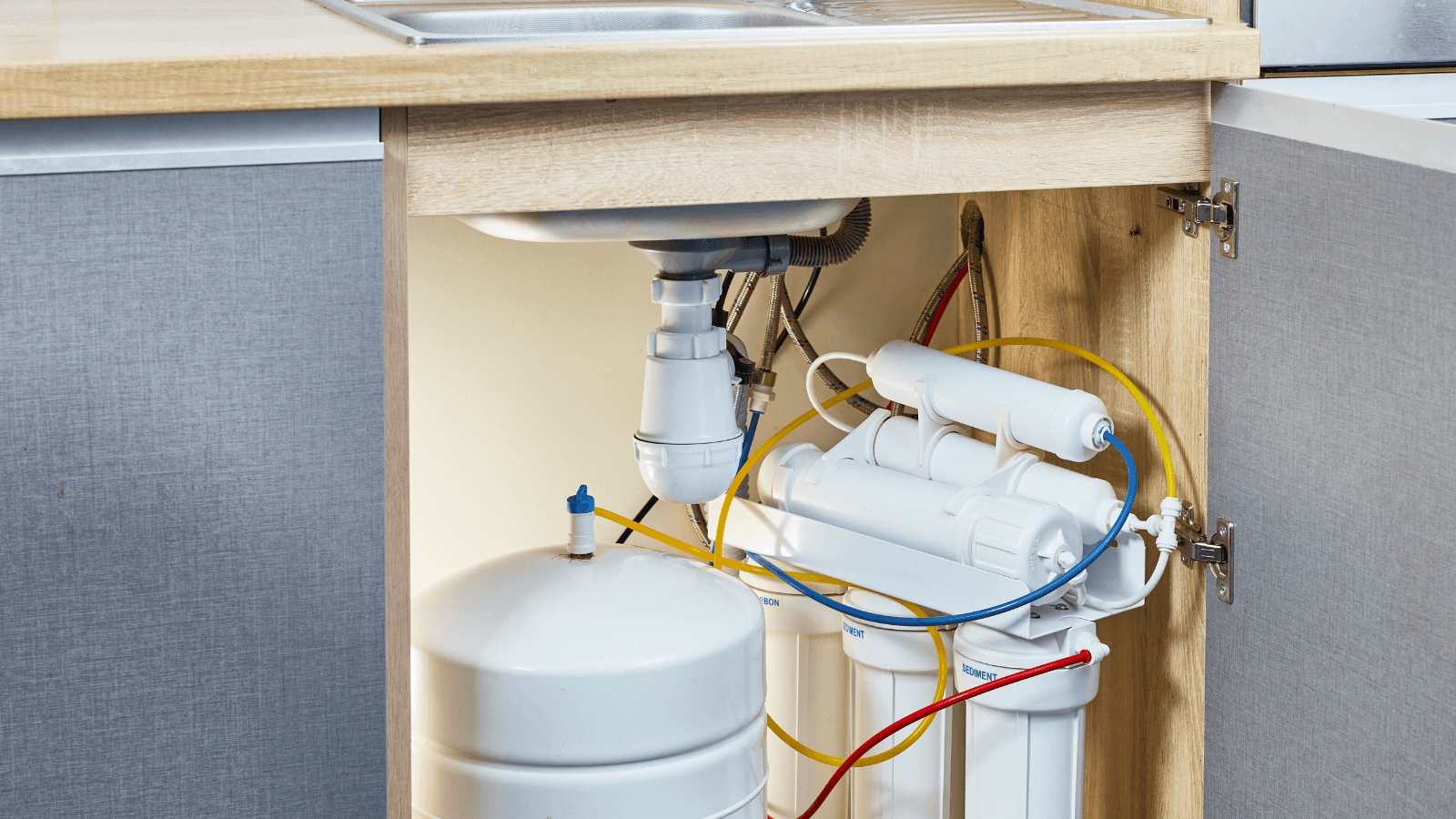
Here's where a lot of people get confused. Reverse osmosis is a drinking water system. Most residential RO units are installed under the kitchen sink and connected to a dedicated faucet. They treat the water at a single point — your drinking and cooking tap. They are not designed to treat every drop of water coming into your home.
If you want to address hard water throughout the whole house — scale on your appliances, film in your shower, dry skin and hair — that's a different problem requiring a different system. A water softener or conditioner handles the hardness minerals that affect your plumbing and fixtures. RO handles the dissolved contaminants in what you drink and cook with. The two systems are complementary, not interchangeable.
A lot of families end up with both: a softener or conditioner for the whole house and an RO system under the kitchen sink. It sounds like more than you need until you understand that they're solving genuinely different problems.
Does RO Remove Minerals You Need?
This is the question that comes up the most, and it deserves an honest answer rather than a dismissive one.
Yes, RO removes calcium and magnesium along with everything else. The membrane is thorough — it removes 92-99% of most dissolved minerals, beneficial or not. The World Health Organization has noted in research on demineralized water that some evidence links long-term consumption of very low-mineral water to potential cardiovascular and bone health concerns, though the science here is still developing and not conclusive for people eating a normal diet.
The reality is that for most people, the minerals in their drinking water represent a small fraction of total daily mineral intake. Your food — vegetables, dairy, whole grains — contributes far more calcium and magnesium than your water does. That said, the concern is real enough that it's worth acknowledging.
If it bothers you, there's a simple solution: a remineralization post-filter stage, which adds a controlled amount of calcium and magnesium back into the water after it comes through the membrane. It's a standard add-on that many RO systems support. When Dan installs an RO system for a family with that concern, adding a remineralization stage is a straightforward option.
The Water Waste Question
The EPA is direct about this one: a typical point-of-use RO system generates five gallons or more of reject water for every one gallon of treated water it produces. That reject water goes down the drain.
If water conservation is a priority for your household, this is worth factoring in. Some newer, higher-efficiency systems have improved that ratio significantly — some are approaching 1:1 — but traditional systems are less efficient. It's not a reason to rule out RO, but it's a real trade-off to know about before you decide.
Who Actually Needs an RO System
An RO system makes the most sense when:
Your water test shows contaminants that carbon filtration alone doesn't address well — PFAS, nitrates, arsenic, heavy metals, or very high TDS. RO is the most reliable removal method for all of these.
You're on a private well. Well water has no regulatory oversight and often contains iron, bacteria, nitrates, and other contaminants at levels that benefit from RO treatment at the drinking tap, even if you have broader well water treatment in place.
You're currently buying bottled water. If you're spending money on bottled water because you don't trust the tap, an RO system produces better-quality water at a fraction of the per-gallon cost. The system pays for itself relatively quickly.
You have specific health concerns — a family member going through chemotherapy, an infant, someone with a compromised immune system. RO's thoroughness becomes more relevant when you need a very high degree of certainty about what's in the glass.
An RO system may not be the right starting point when your water test shows that a simpler filter would handle your actual contaminants, or when the primary concern is hardness rather than dissolved contaminants. The test tells you the answer. Buying a system without one is guessing.
What Maintenance Looks Like
RO systems have filters that need to be replaced periodically — typically pre-filters every six to twelve months and the membrane every two to five years depending on usage and incoming water quality. Annual professional service keeps the system performing correctly and catches membrane degradation before it affects water quality.
This is one reason it matters who installs your system and who supports it afterward. An RO system that isn't maintained properly will eventually stop removing what it's supposed to remove, often without any visible sign that anything has changed.
The Bottom Line
Reverse osmosis is not a magic fix for every water problem, and it is not overkill for every home. It is the most thorough option available for removing dissolved contaminants from drinking water — including things like PFAS that other filter types don't address as reliably.
Whether you need one depends on what's actually in your water. The only way to know that is to test it.
Mountain View Pure Water and Air offers free in-home water testing throughout the Tri-Cities and surrounding region. We test your water, show you exactly what we find, and give you an honest read on what kind of treatment — if any — makes sense for your home. If an RO system is right for you, we'll explain why and show you what installation and maintenance look like. If it's not, we'll tell you that too.
Schedule your free water test at mvpwater.net or call 423-218-9361.