Bristol is one city with two water systems, and which one serves you depends on which side of the state line your house sits on. That's not a quirk to gloss over. It changes your source water, your treatment, and, as it turns out, the specific contaminants in your glass. So the first thing to know about Bristol water quality is: which Bristol are you actually on?
The two-utility reality
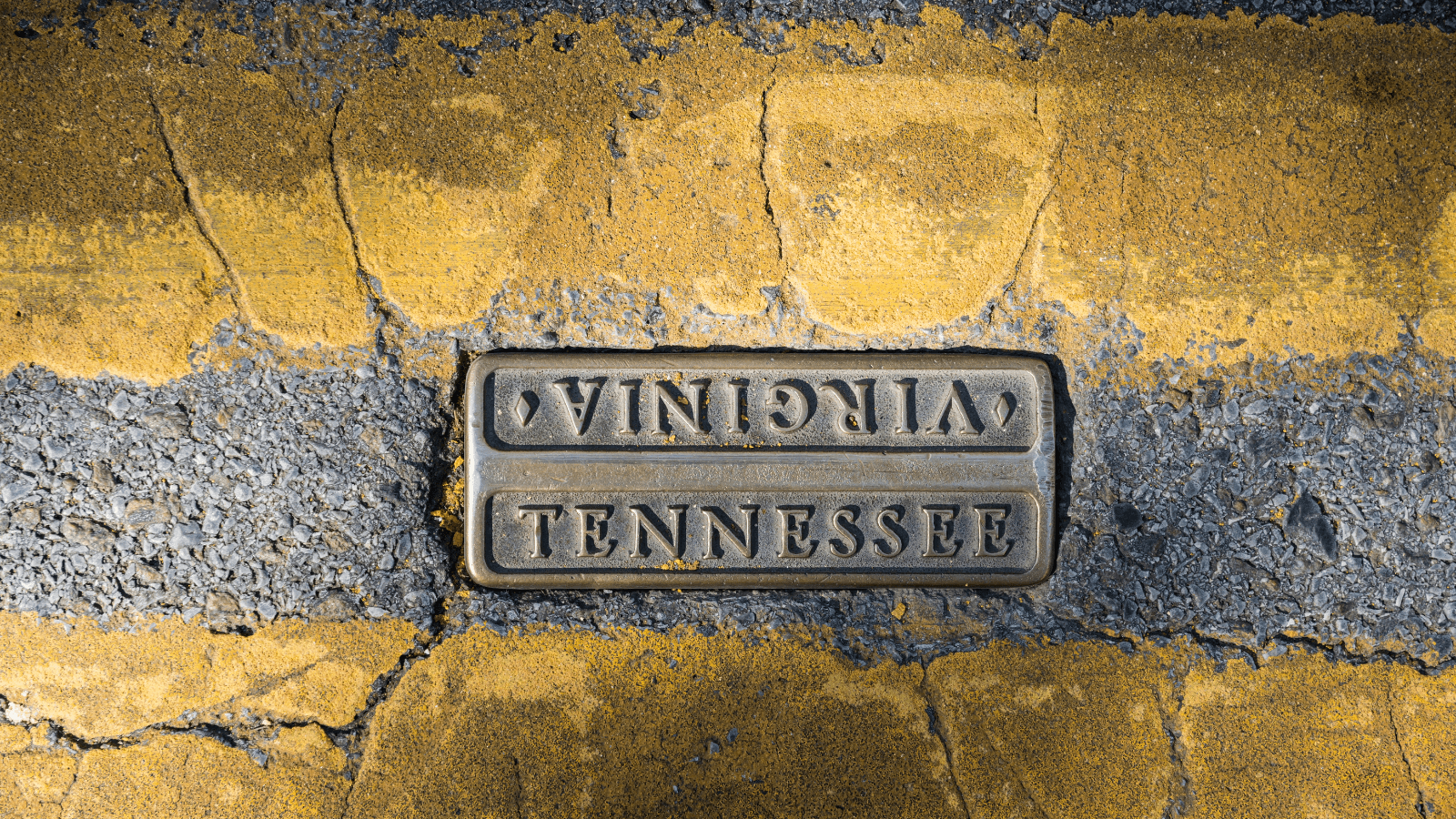
The Tennessee side is served by Bristol Tennessee Utility Services, and the Virginia side by BVU Authority (Bristol Virginia Utilities). They're separate utilities with separate infrastructure, and famous State Street roughly follows the line between them (Source: City of Bristol, TN; BVU Authority). If you've ever wondered why your neighbor's water tastes a little different or why their bill comes from a different place, this is why. To find out which one serves you, just look at your water bill.
And here's what most people don't realize: the two systems don't just have different names. They pull from different intakes, treat the water differently, and end up with different contaminants at the tap. Bristol Tennessee draws from the South Holston River, from an intake near the South Holston Dam, and pumps it to a treatment plant capable of producing up to 10 million gallons a day (Source: City of Bristol, TN). Bristol Virginia draws from South Holston Lake, piped about two miles to BVU's water filtration plant in Abingdon, Virginia (Source: Virginia DEQ; BVU Authority). The river feeds the lake, so the two are hydrologically connected, but because the intakes sit in different places and the treatment chemistry differs, the water on one side of State Street isn't the same as the water on the other.
The Tennessee side, and a surprising paradox
Bristol Tennessee serves roughly 12,000 direct customers and, counting five surrounding utility districts, a total service population of over 40,000, drawing from what's considered one of the cleanest source waters in Northeast Tennessee (Source: City of Bristol, TN). The intake sits near South Holston Dam, and for the most recent quarter assessed by the EPA, the system was in compliance with federal health-based standards (Source: EWG Tap Water Database).
Here's the paradox, and it's the most interesting thing about Bristol TN's water. Despite that excellent source, Bristol Tennessee has the highest haloacetic acid level (HAA5) of any major Tri-Cities utility, higher even than Kingsport (Source: EWG Tap Water Database, Bristol Tennessee). That sounds like a contradiction until you understand where these contaminants come from. Haloacetic acids and trihalomethanes are disinfection byproducts, and they aren't really a source-water problem. They form when the chlorine that keeps water safe reacts with natural organic matter, and the longer the treated water sits in the distribution system, the more of them form (Source: U.S. EPA). So a clean source plus the necessary chlorination plus contact time in the pipes can still produce high byproduct levels. It isn't a failure of the plant. It's just how the chemistry works.
The Virginia side, a different profile
Cross State Street and the story changes. Bristol Virginia serves folks in the City of Bristol, Virginia and parts of Washington County, and its water actually carries more flagged contaminants than the Tennessee side, eleven above EWG's health guidelines versus nine (Source: Virginia DEQ; EWG Tap Water Database, Bristol Virginia). Its disinfection byproducts are lower than Bristol TN's, but it has three things the Tennessee side doesn't: measurable radium, chromium-6, and elevated nitrate.
Those three are worth understanding plainly. Radium occurs naturally in some geology and can concentrate in surface water; it's a known cancer risk at elevated levels. Chromium-6 is the contaminant made famous by the Erin Brockovich case, and it has no federal legal limit at all. Nitrate above a certain point matters most for infants. None of these is at a level that triggers regulatory action, and BVU's water is in full federal compliance (Source: Virginia DEQ; EWG Tap Water Database). But they're real, they're specific to the Virginia side, and a pitcher filter on the kitchen counter does nothing for any of them.
Why this matters for your family
Whichever side you're on, the disinfection byproducts deserve a plain explanation, because the exposure works in a way most people don't expect. These are the same compounds the EPA regulates under its Stage 2 Disinfectants and Disinfection Byproducts Rule, because long-term exposure has been associated with bladder cancer and, in the research, with pregnancy complications (Source: U.S. EPA; systematic review and dose-response meta-analysis, PubMed Central, 2024). The evidence is clearest for exposure measured in years, not weeks, which is worth thinking about if your family has been on Bristol water for a while.
And much of that exposure doesn't happen at the kitchen sink. Disinfection byproducts are volatile, so when you heat water in a shower, a bath, or the dishwasher, they off-gas into the air, and you absorb them through your lungs and skin. Epidemiological research has found that inhalation and dermal absorption during showering and bathing are a meaningful exposure route for these compounds, and one risk assessment found inhalation to be the largest single route (Source: American Journal of Epidemiology; Environment International). That's the part a pitcher filter can't reach: a filter on one faucet does nothing for the shower your kids take every night. A whole-home carbon system handles it at every tap, on either side of State Street, which is exactly what EWG recommends for the contaminants in both Bristol systems.
What both sides share: hard water
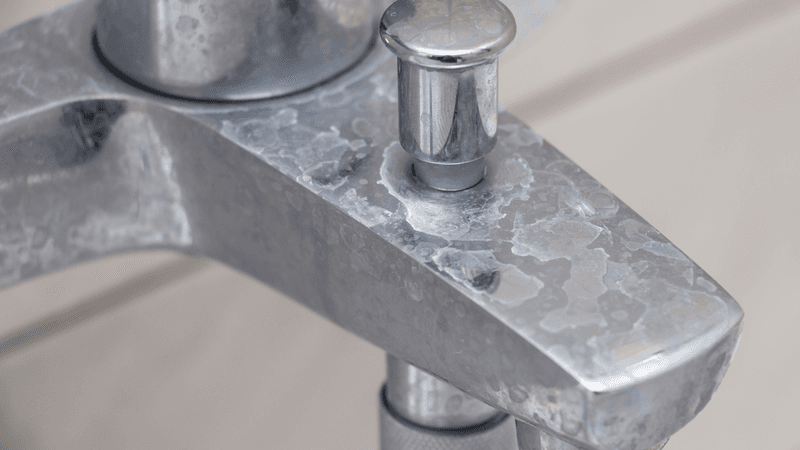
Geology doesn't care about the state line. Both sides of Bristol sit on the same Appalachian limestone and dolomite bedrock, and that rock dissolves calcium and magnesium into the water no matter which utility treats it (Source: USGS). So hardness is a shared Bristol reality. If you're seeing white crust on the kettle, spotted glasses, and soap that won't lather, that's the limestone talking, and it's the same story we cover for the whole region in our post on the signs of hard water.
Hard water isn't a health risk, but it quietly costs Bristol families real money. Scale builds up inside water heaters, dishwashers, washing machines, and pipes. In the landmark 2009 Battelle Memorial Institute study commissioned by the Water Quality Research Foundation, hard water caused water heaters to lose as much as 48 percent of their efficiency, while heaters on softened water held their factory efficiency across a 15-year test, and showerheads on hard water lost about 75 percent of their flow within 18 months (Source: Battelle Memorial Institute / Water Quality Research Foundation, 2009). Spread across utility bills, detergent, and appliances that wear out early, most households are losing real money to it without noticing.
How to know what's actually at your tap
Any utility report gives you a system average, not your tap. It can't account for your neighborhood, your home's age, your plumbing, or exactly how long the water sat in the pipes before it reached you. Two homes on the same street can test differently. That's the gap a real test fills. We'll test your Bristol water for free, tell you which utility you're on, show you how your levels compare to the health guidelines, and measure your exact hardness in grains per gallon, whichever side of State Street you're on. Call 423-218-9361 or book at mvpwater.net. We also serve nearby Bluff City and the surrounding Sullivan and Washington County areas.